How to Teach Game Rules to Non-Gamers in 30 Minutes
Working memory holds about four chunks; an RPG system holds hundreds. How we teach Daggerheart to complete beginners in 30 minutes, first roll in five.
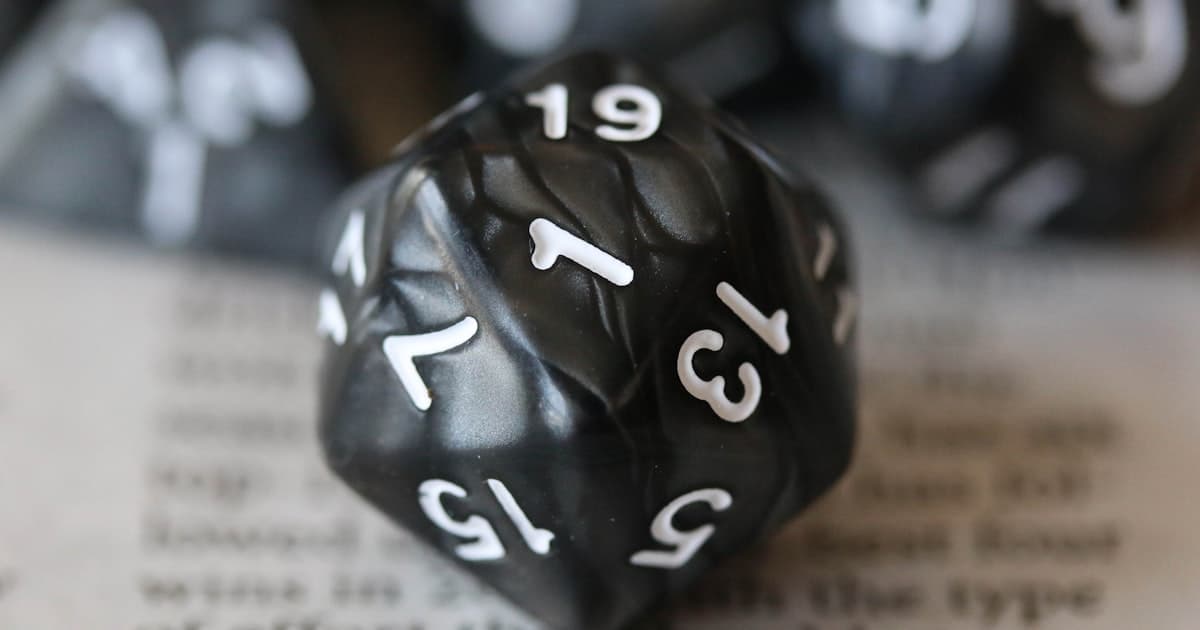
The character sheets we hand players at the start of an Operation Aetherfall session are half a page long. Daggerheart – the system our scenario runs on – is a complete roleplaying game, with classes and advancement and enough interlocking parts to sustain a campaign for years. Our players never see most of it. They get five things, a half sheet of paper, and 30 minutes.
To teach RPG rules to beginners, teach one loop and almost nothing else: roll dice, compare the result to a difficulty number, find out what happens. Get dice into someone's hand inside the first five minutes. Give each player a stripped-down sheet holding only their own abilities, and let the game master quietly carry every other rule in the book. Thirty minutes is enough – and the constraint isn't a scheduling compromise. Adults can hold roughly four chunks of new information in working memory at a time. A full RPG system holds hundreds. The only way the math works is to refuse to teach the system.
Adam White and I have run this teach through two full pilots of Operation Aetherfall, our conflict-training scenario, with rooms that included people who hadn't rolled dice since Monopoly. Adam's a licensed counselor and a Game to Grow-trained game master; I'm a product manager, and the half-page version exists partly because I needed it too. Rules teaching is Block 5 of our session format, wedged between an hour of pre-game instruction and roughly four hours of play – the full run-of-show is in our guide to how to run a tabletop RPG training session.
Why does teaching fewer rules produce more learning?
Working memory is the bottleneck every lesson has to pass through, and it's small. George Miller's famous estimate was seven items, plus or minus two. More recent studies, run under controlled conditions that prevent rehearsal and chunking tricks, put the real capacity for new, interacting information closer to four – plus or minus one. Nothing reaches long-term memory without passing through that four-slot channel first. Pour in more and the overload research is blunt about what you get: confusion, frustration, less learning. In one line of educational research, more than 80% of learners with weak working memory missed expected outcomes when the information exceeded what they could process.
Cognitive load theory splits the demand on those four slots into three kinds: intrinsic load (the real complexity of the thing being learned), extraneous load (effort spent on anything that doesn't serve the learning), and germane load (the useful work of wiring new material into what you already know).
Here's the uncomfortable part for anyone who loves games: in a training session, the rules are extraneous load. Nobody in an Operation Aetherfall pilot is there to master Daggerheart. They're there to practice disagreeing with a commander, surfacing hidden information, building consensus under pressure. Every mechanic I teach spends working memory the participants need for the actual curriculum. Our session plan states the design goal in a single line: minimize cognitive load from game mechanics so mental energy goes toward the interpersonal dynamics. When workplace training doesn't stick, overload is one of the quieter culprits – the lesson never got a free slot.
The same research points at the fix. Studies of professional training programs found that chunking complex procedures into three- to four-step sequences produced better outcomes than presenting all the steps at once. One loop, taught as one chunk, practiced before the next chunk arrives.
What do you cut, and what has to stay?
Keep whatever a player needs in order to act on their own turn. Cut whatever the game master can carry for them. In our pilots, that rule reduced Daggerheart to Level 1, pre-generated characters, and a walkthrough of exactly five things:
| Mechanic | How much to teach | Who carries it |
|---|---|---|
| Skill checks – roll, compare to difficulty | The full loop. This is the lesson. | Players |
| Attack rolls and damage | One pass – it's the same loop holding a weapon | Players, with prompting |
| Stress and HP | Tracking only – mark the boxes when told | Players |
| Hope and Fear economy | A sentence or two – the note in our session plan reads "enough to play, not to master" | The GM |
| Character abilities | Each player reads their own half-page sheet, nobody else's | Each player |
| Everything else – conditions, edge cases, optional rules | Nothing. Don't reveal it exists. | The GM, silently |
Look at the shape of that list. One core loop, one variant of the loop, two bookkeeping habits, one short private reading. Squint and it's about four chunks. It fits the channel.
Pre-generated characters are the biggest single cut, and the easiest to defend – character creation is the most option-dense hour in any RPG, and none of those options serve a first-time player in a training room. The other half of the cognitive load literature helps too: adults process new material as fewer chunks when it connects to something they already know. "Roll and compare to a target" is Yahtzee with consequences. Hit points are a health bar. You're not teaching from zero; you're renaming things they've owned for decades.
Why should the first roll happen in the first five minutes?
Explanation doesn't consolidate learning – practice does. The instructional research behind our design says to present information sequentially and give learners time to consolidate each chunk before the next one lands. Applied to a game table, that means you don't deliver a fifteen-minute rules lecture and then start playing. You explain the loop in two sentences, put dice in everyone's hands, and have each player make a throwaway check before a second mechanic gets mentioned.
The early roll does psychological work too. For a non-gamer, the dice are the exam – the moment they're most afraid of getting wrong. Making the first roll immediate, low-stakes, and communal drains that fear before it can compound. Once they've done the scary thing and the ceiling didn't fall, there's nothing left to dread.
Then the game takes over as the practice structure. Four hours of play is four hours of spaced repetition on a single loop. By the second hour nobody's thinking about mechanics at all, which is exactly the goal. The mechanics were never the lesson.
How do you handle the rules lawyer and the overwhelmed player?
Every mixed room produces both, and they need opposite moves.
The rules lawyer is usually the one experienced gamer in a corporate group, and their questions are sincere – they can see the parts you cut, and it itches. The move is to name the cut instead of litigating it: "That rule exists. We're not using it today." Then give them a job. Ask them to model the first check, or quietly help the neighbor who's lost. Deputizing converts a challenge into an asset. What you can't do is answer edge-case questions in front of the room, because every exception you explain publicly is a chunk stolen from someone already at capacity. Park it – "find me at the break, I'd genuinely enjoy that conversation." I say this with some tenderness, because I've been that guy at other people's tables.
The overwhelmed player sends the opposite signal: quiet, nodding too much, eyes fixed somewhere past the character sheet. The move is to shrink the game to their half page. "Everything you need is on that sheet. Everything not on it is my job." When their first check comes up in play, feed them the loop step by step, in character, without ceremony. Never quiz them publicly, and never make their catch-up a table event. The half-page sheet was designed for exactly this person – there's nothing to fall behind on, because there's almost nothing to hold.
What did the 30-minute block actually look like in our pilots?
In our Pilot 2 session plan, rules teaching is budgeted at 25 to 30 minutes inside a seven-and-a-half-hour day. It sits after an hour of pre-game instruction – framing, safety tools, and two conflict concepts – and right before roughly four hours of play, with a ten-minute break in between. Where each block sits in the day, and what to shorten when things run long, is its own topic: game-based training day logistics.
The sequence inside the block: hand out the six half-page character sheets, walk through the five mechanics in the table above, then give each player two face-down cards – a secret motivation and a piece of secret information – with two or three minutes to read privately. The motivation card comes with one instruction: "Lean into it – even if it creates friction with the group. That friction is the point." The secret cards aren't rules at all; they're the scenario's conflict engine, and designing them is a separate craft.
Notice what the block never includes: a comprehension check. No quiz, no "everybody got it?", no round-the-table recital. The first scene of the game is the comprehension check, with a game master standing by to catch anyone who drops the loop.
Does this work for teaching board game rules?
Same bottleneck, same move. To teach a board game's rules, teach one complete turn – what a player can do when it's their go – and make the first round an open-handed practice round that doesn't count. Scoring can wait until someone's about to score. Edge cases get resolved when they occur, by whoever actually read the rulebook. In a board game group, that person is the GM whether they wanted the job or not.
The 30-minute number isn't really a rules-teaching budget. It's a working-memory budget, and most of it gets spent on restraint. Adam could walk a table through the entire Daggerheart system. We teach five things off a half page instead, because the rules were never the curriculum.
Teach the loop. The system can wait.
More from Facilitation

Logistics for a Game-Based Training Day: People, Time, Room, Materials
The planning checklist behind a 7.5-hour game-based training day – group size, timing budget, breaks, room setup, printed materials, and facilitator prep.

How to Frame a Roleplay Exercise So Adults Actually Engage
The pre-game briefing decides whether adults commit or cringe. The scripts from our Operation Aetherfall pilots, the psychology, and a ten-minute checklist.

How to Run a Tabletop RPG Training Session at Work
A facilitator's guide to running a tabletop RPG training session at work – materials, framing, safety tools, teaching rules to non-gamers, and the debrief.
Put this into practice
Operation Aetherfall is a complete, pilot-tested scenario kit — facilitator guide, printable table pack, and assessment set — for running this kind of training with your own team.